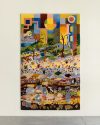
The word Dreamshook[1] describes the feeling of waking from a dream, when reality is destabilised and realms of possibility linger and dissipate. Nolan’s exhibition of hand-tufted tapestry, drawing, and sculpture, represents thresholds, dream states and narratives that strain the distinctions between the immaterial and the actual. The work develops from her sustained fascination with the human desire to find meaning or order in the universe, and the frameworks that shape our understanding of the world.
Nolan looks to the Middle Ages and early Renaissance as an era that resonates with now. It was a turbulent period marked by religious and political upheaval, a time transformed by plague, wars and famine. Cultural and technological developments in Europe cultivated profound ideological change, challenged the nature of authority, and reshaped what it might mean to be human. The work draws on artefacts and ideas from those formative times that helped pattern the present-day: from the emergence of humanism, dramatic developments in Italian painting and architecture; to the invention of the printing press and the use of moveable type in Europe.
She focuses on the figure of Aldo Manuzio (c.1450–1515), an innovative, influential printer and publisher based in Venice. As the century turned Manuzio, widely known as Aldus Manutius, transformed the culture of reading in small and large ways: introducing the semi-colon and italics; and more significantly producing numerous, portable enchiridons (pocket-sized books), beautifully designed with wide margins and modern typography. In his promotion of key writings by influential contemporary humanists and numerous Greek and Roman classical works – newly, conscientiously edited and never before published in Europe – he hoped to champion the idea of human perfectibility and foster a more ‘civilised’ world.
At the centre of the exhibition is a pair of large-scale arched tapestries featuring apparitions. In Aldus Dreams of a Plentiful Supply of Good Books (2026), Nolan imagines Aldos’ dream with numerous nods to the art and architecture the early Renaissance. Nearby, Dreamshook (2026) stages an unyielding bed adrift on an unstable floor, a loose constellation of abstract forms. It is accompanied by Oh! (2026), a curtain that seems paradoxically still and in motion. A cluster of drawings capture fragments of thought—quotes, annotations, and speculative reflections on dreams and readers across time. Moving fluidly between the intimate and the expansive, the tangible and the imagined, the exhibition invites viewers into a space where dreams press insistently on reality—shaping it, unsettling it, and revealing its hidden contours.
From Manuzio’s ambitions to publish “a plentiful supply of books,” to moments of hope and transformation, Nolan invokes these histories to signal how the architectures of belief and knowledge we inhabit often stretch the limits of credibility. Drawing on literature, history, religion, and mythology, the works ground far-reaching subjects in intimate, material encounters, exploring how meaning and connection are forged in the turmoil of the present day. Dreamshook invites speculation on how the dynamics of wonder, belief and power shape both expectations and human experience, and how we encounter the world in all its messiness and debatable beauty.
[1] The word “dreamshook” was coined by Nolan in 2017.